The New HTTP QUERY Method: Why HTTP Finally Got a New Request Method
Have you ever needed to send a complex search request to your API and wondered:
"Why am I forced to use POST for something that only reads data?"
For years, developers have been using POST as a workaround because GET wasn't designed for large or complex queries.
That finally changes.
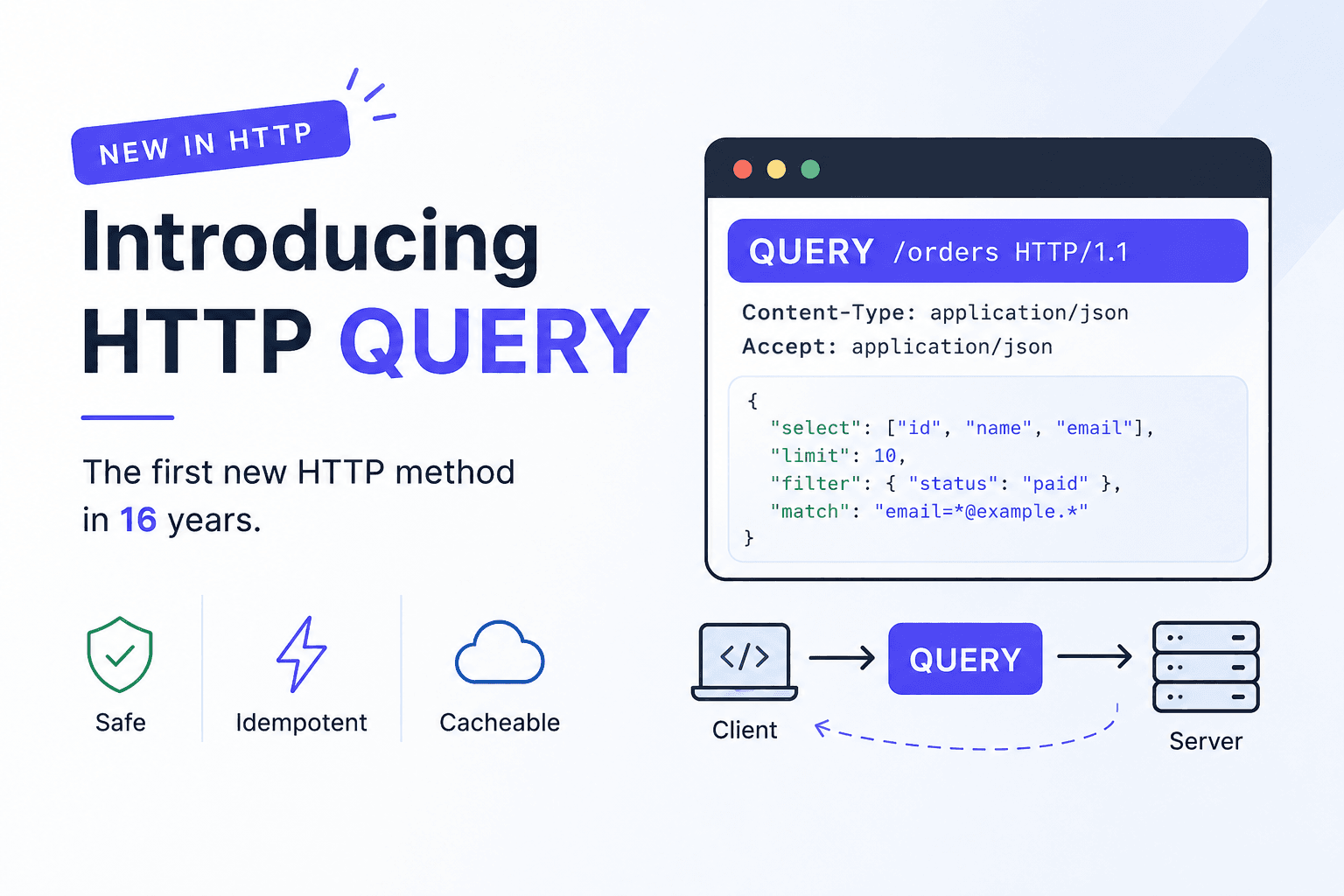
In June 2026, HTTP introduced its first new standard request method in 16 years: QUERY.
It combines the best parts of GET and POST into a single request method designed specifically for read-only requests with a request body.
Why Was QUERY Introduced?
Imagine you're building an API to search users.
A simple GET request works fine at first.
GET /users?role=developer&country=India&limit=10Click to Copy
But requirements grow.
You now need:
- Multiple filters
- Nested conditions
- JSON queries
- SQL-like expressions
- Large request payloads
Your URL quickly becomes difficult to read and maintain.
GET /users?select=name,email,skills&limit=10&role=developer&country=India&experience=5&skills=react,nextjs,typescript&sort=experienceClick to Copy
Problems with GET
- URLs have practical size limits.
- Query parameters appear in browser history and server logs.
- Difficult to send structured JSON.
- Complex encoding becomes painful.
- Not ideal for advanced search APIs.
Why Not Just Use POST?
Most developers eventually switch to POST.
POST /users/search
Content-Type: application/json

{
  "select": [
    "name",
    "email",
    "skills"
  ],
  "role": "developer",
  "country": "India",
  "experience": {
    "gte": 5
  },
  "skills": [
    "React",
    "Next.js",
    "TypeScript"
  ],
  "limit": 10,
  "sort": "experience"
}Click to Copy
While this solves the payload problem, it introduces another one.
POST was designed for creating or modifying resources, not searching.
That means:
- Not inherently idempotent.
- Harder to cache.
- Proxies don't know whether replaying the request is safe.
- Every framework invents its own "safe POST" convention.
Meet QUERY
QUERY is a new HTTP request method specifically designed for read-only operations that require a request body.
Example:
QUERY /users
Content-Type: application/json
Accept: application/json

{
  "select": [
    "name",
    "email",
    "skills"
  ],
  "role": "developer",
  "country": "India",
  "experience": {
    "gte": 5
  },
  "skills": [
    "React",
    "Next.js",
    "TypeScript"
  ],
  "limit": 10,
  "sort": "experience"
}Click to Copy
Think of it as:
A GET-like request that supports a request body.
Key Benefits
✅ Request Body Support
Unlike GET, QUERY allows sending large and structured payloads.
Perfect for:
- JSON filters
- SQL-like queries
- Graph searches
- Elasticsearch queries
- JSONPath expressions
✅ Safe
QUERY never changes server state.
It is intended only for retrieving data.
✅ Idempotent
Running the same QUERY request multiple times has the same effect as running it once.
Example:
QUERY /users

{
  "role": "developer",
  "country": "India"
}Click to Copy
Calling it once or ten times simply retrieves matching users.
Unlike:
POST /usersClick to Copy
which may create multiple users if repeated.
✅ Cacheable
Since QUERY is safe and idempotent, proxies, CDNs, and browsers can cache responses much like GET.
This makes complex search endpoints much more efficient.
✅ Easier API Design
Instead of creating multiple endpoints:
GET /users/developers
GET /users/designers
GET /users/managers
GET /users/remoteClick to Copy
You can expose a single endpoint:
QUERY /usersClick to Copy
with all filters inside the request body.
For example:
{
  "role": "developer",
  "country": "India",
  "remote": true
}Click to Copy
This keeps APIs:
- Cleaner
- Easier to maintain
- Easier to document
- More flexible
Example Use Cases
QUERY is especially useful for:
- Advanced search APIs
- Analytics dashboards
- Reporting systems
- Elasticsearch queries
- GraphQL-style filtering
- SQL or JSON-based search APIs
- Data exploration tools
Current Adoption
Although QUERY is now an official HTTP method, support is still limited.
Status
- ✅ Standardized (RFC 10008 – June 2026)
- ⏳ Limited support in servers and frameworks
- ⏳ Limited support in HTTP clients and API tools
- 🚀 Wider adoption is expected over the next few years
For now, it's more important to understand the concept than to start using it in production.
Final Thoughts
For years, developers had to choose between:
- GET, which struggles with large or complex queries.
- POST, which works technically but isn't semantically correct for read-only operations.
The new QUERY method fills that gap by providing a standardized way to send complex, read-only requests with a request body while retaining the safety, idempotency, and cacheability of GET.
That said, QUERY is still very new. Although it was standardized in June 2026 (RFC 10008), support across servers, frameworks, browsers, proxies, and API tools is still limited. It will likely take some time before it becomes widely adopted.
Until then, you probably won't be using QUERY in production just yet—but it's definitely worth understanding. As the HTTP ecosystem evolves, understanding standards like QUERY will help you design cleaner, more expressive APIs as support continues to grow.